English
 Español
Last week, a packaging producer reached out with a problem that sounded all too familiar. They were making a 3-layer barrier film for frozen food, had chosen an ABA configuration to save money on raw materials, but after six months of production, their customer was complaining about inconsistent seal strength and layer delamination at low temperatures. “We thought all 3-layer lines were basically the same,” they said. “Turns out we left a lot of performance on the table.”
That conversation highlights a decision point that too many processors treat as a minor checkbox: the choice between ABA and ABC screw configurations in a multi-layer line. The letters look similar on a spec sheet, but the way they shape your cost structure, product performance, and even your sustainability profile is fundamentally different.
What ABA and ABC Actually Mean
In a three-layer coextrusion setup, you have three extruders feeding a single die. The letter designation tells you which extruder does what.
-
ABA: The two “A” extruders process the same material (typically a polyolefin like LDPE or LLDPE), forming the inner and outer skins. The “B” extruder – the middle layer – carries a different material, often a barrier resin like EVOH or PA, or a recycled-content core. The structure is symmetrical: A on both sides, B in the center.
-
ABC: All three extruders process distinct materials. You might have a polyolefin sealant layer (C), a tie layer or structural bulk in the middle (B), and a high-barrier or high-gloss outer layer (A). Each layer is independently formulated, giving you complete freedom to build a film exactly to spec.
The symmetry of ABA makes it simpler to run, but the asymmetry of ABC unlocks far greater design flexibility. Understanding this fundamental difference is the first step when configuring a high-performance multi-layer blown film production system. The right choice depends less on machine cost and more on what the film needs to do on the customer’s packaging line.
Where ABA Shines: Cost Efficiency and Recycled Content
ABA’s biggest advantage is straightforward economics. Because layers A and A are identical, you can source one resin in large volume, negotiate better pricing, and simplify your inventory. Many processors also use the B layer as a hiding place for post-industrial scrap or PCR (post-consumer recycled) material, easily pushing recycled content above 30% without sacrificing surface quality or food-contact compliance on the skins.
Typical applications where ABA makes sense:
-
Heavy-duty shipping sacks and industrial liners where gauge and toughness matter more than precise gas barrier.
-
Agricultural films where UV-stabilized LDPE on both sides encapsulates a less expensive, carbon-black-filled middle layer.
-
Retail carry-out bags and thin-gauge films that demand low cost per kilogram above all else.
However, ABA has clear limits. Inter-layer adhesion between the A skin and the B core depends entirely on the inherent compatibility of the two resins. If you need to bond polyolefin to EVOH, you cannot do it without a dedicated tie resin – and ABA has no dedicated tie layer. That forces compromises: either you accept lower adhesion, or you avoid barrier resins that would give your film real differentiation.
Where ABC Wins: High Barrier, High Value
ABC configurations treat each layer as a blank canvas. A common high-barrier food packaging structure might look like: Layer A (HDPE for moisture barrier and stiffness), Layer B (EVOH for oxygen barrier with tie layers pre-compounded), Layer C (metallocene LLDPE for hot-tack and seal integrity). You dial in exactly the performance the application demands.
This design freedom translates into real-world results that are measurable against industry-standard methods. For example, films destined for modified atmosphere packaging of fresh meat need oxygen transmission rates (OTR) below 5 cc/m²·day·atm, tested per ASTM D3985. An optimized ABC structure with a dedicated EVOH core layer and proper tie-resin integration can routinely deliver OTR values an order of magnitude lower than a comparable ABA film of the same gauge.
ABC also excels in scenarios where one side of the film must perform differently from the other – low seal-initiation temperature on the inside, high scratch resistance on the outside, for instance. AB structures simply cannot deliver this functional asymmetry.
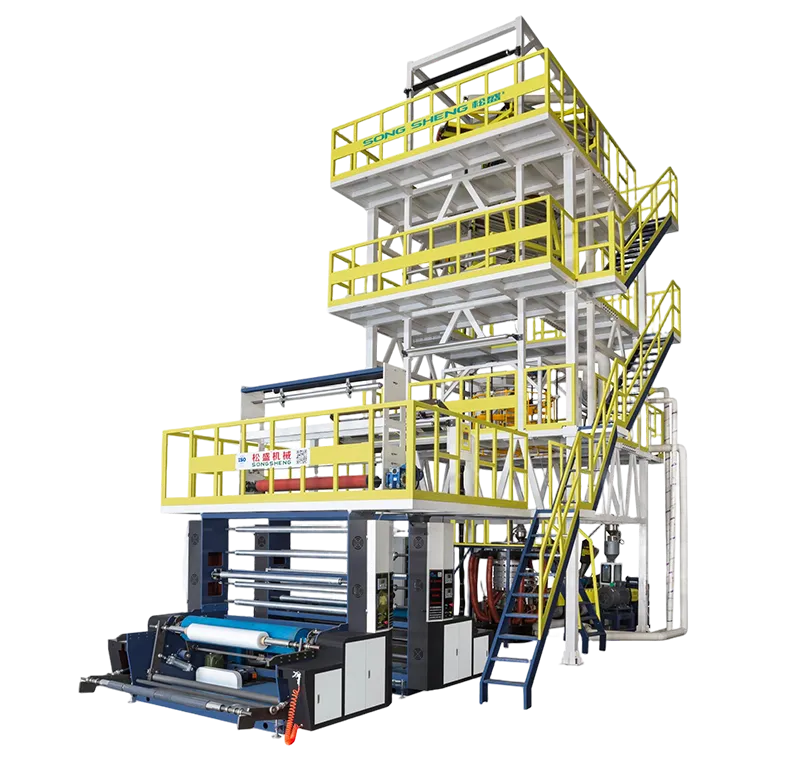
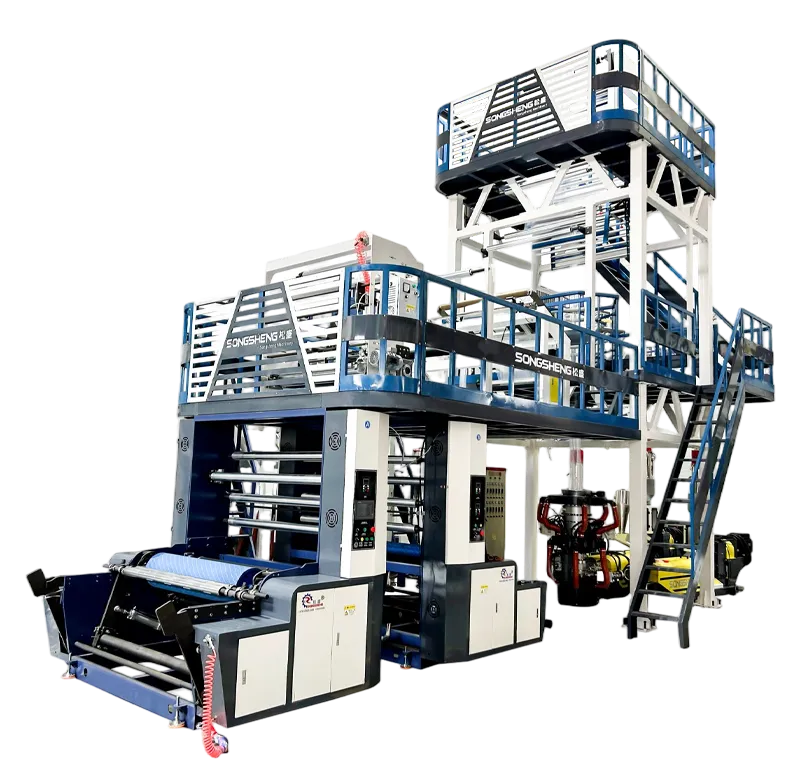
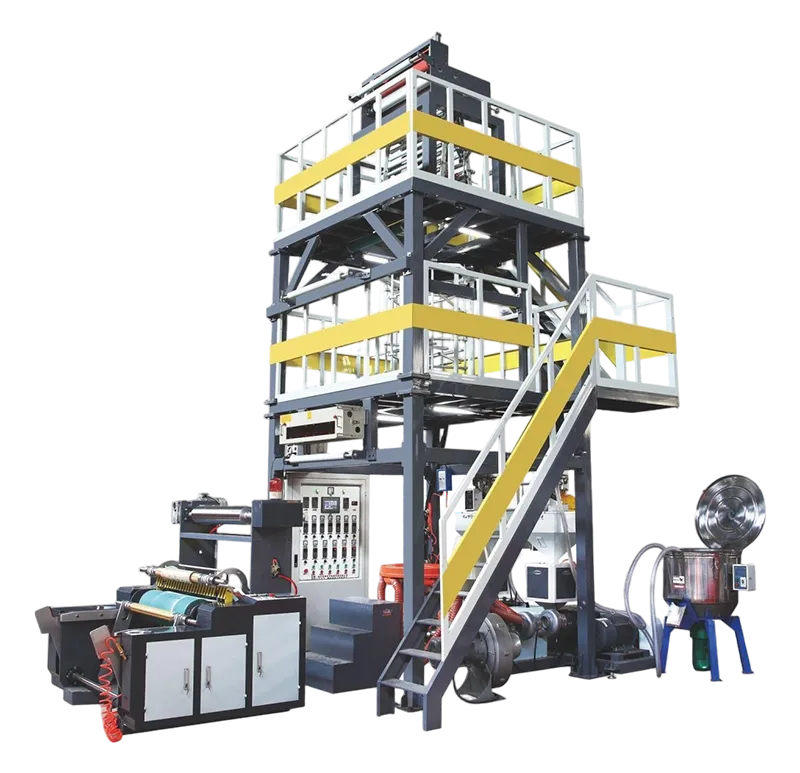
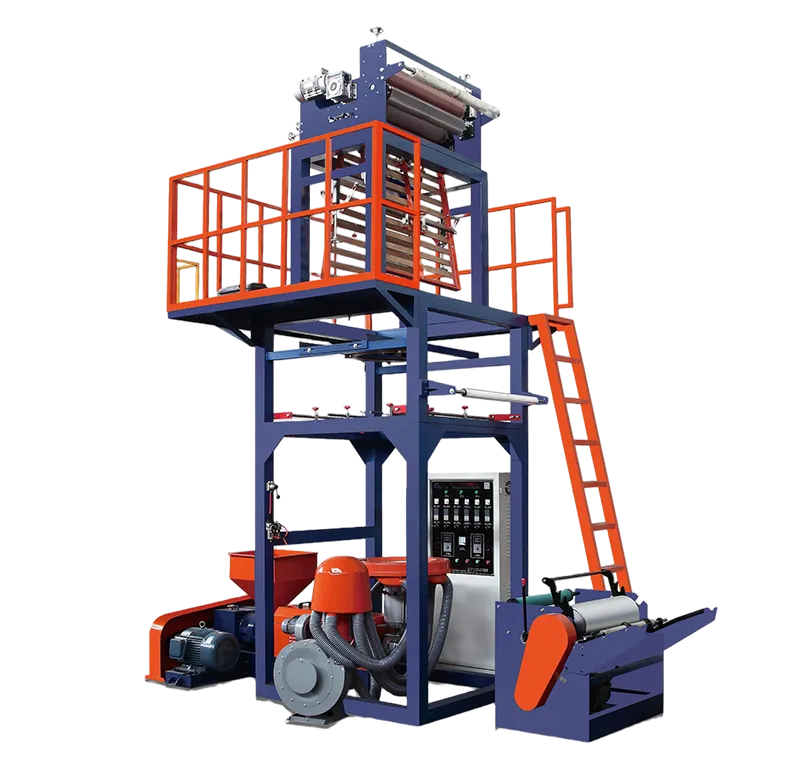
The trade-off is operational complexity. Running three dissimilar materials means managing three different melt temperatures, three different viscosities, and more sophisticated die-gap tuning to maintain layer uniformity. When you need to push output rates while keeping film thickness variation tight, the choice of a modular film blowing line with independent extruder controls becomes a critical factor.
Quick Comparison: ABA vs. ABC at a Glance
| Dimension | ABA Configuration | ABC Configuration |
| Material cost | Lower – bulk purchasing of resin A, recycled core possible | Higher – three separate resin streams |
| Barrier performance | Limited – no dedicated tie layer | Excellent – fully customizable, can include tie resins |
| Layer adhesion | Depends on A/B compatibility | High – tailored tie-layer chemistry |
| Recycled content | Excellent (in core) | Possible, but requires careful design |
| Operational simplicity | Easier startup, fewer variables | Higher operator skill required |
| Film design flexibility | Symmetric only | Asymmetric, functional surfaces possible |
| Common applications | Industrial liners, agricultural film, trash bags | Food barrier packaging, medical films, specialty laminates |
This table oversimplifies in one important way: there is no universal “better.” The right choice is entirely a function of what your target market values. If you compete on price per roll and serve the agricultural sector, ABA likely aligns with your cost structure. If you’re chasing margins in high-barrier food packaging, ABC’s performance envelope is hard to match without it.
How to Decide Without Overinvesting – or Underinvesting
Before committing to a configuration, walk through these four questions with your technical team:
-
What are the must-have barrier requirements? Get specific numbers – OTR, WVTR – that your largest customers require. If they fall into territory only achievable with EVOH or PA, and the structure needs a tie layer, you’re in ABC territory.
-
How important is recycled content to your pipeline? If brands are pushing for PCR commitments and you need to hit 30% or higher across the portfolio, ABA’s ability to bury regrind in the core is a genuine strategic asset.
-
What is your operators’ experience level? ABC systems demand tighter process control. If your team is already comfortable running a coextrusion line with independent temperature zones and gauge profiling, the learning curve is manageable. If you’re upgrading from a monolayer line, factor in training time.
-
Do you need to switch between ABA and ABC in the future? Some modular platforms allow reconfiguration between modes. If your product roadmap is still evolving, this flexibility can protect your capital investment and avoid the need for a second line down the road.
A common pitfall we see is processors buying an ABA line to save upfront cost, then spending years trying to tweak resin formulations to hit barrier specs that the screw configuration simply cannot deliver. The machine cost differential shrinks quickly when measured against lost contracts or downgraded film.
Matching Your Product Ambition with the Right Platform
Choosing between ABA and ABC is ultimately a business strategy question that happens to involve extruder screws. It requires aligning your equipment capabilities with the specific performance values your customers will pay for.
If you are evaluating multi-layer production platforms and want to understand how different configurations impact your actual product economics, it helps to speak with engineers who have designed lines for both ABA and ABC applications. MOLDVOLT’s team has worked with processors across food packaging, agricultural, and industrial film segments to match configuration to product requirement – and to avoid the costly mismatch that the frozen-food producer experienced. Explore MOLDVOLT’s configurable coextrusion solutions to see how modular screw and die options can support your application without locking you into a configuration you will outgrow.
The letters matter. Now you have the framework to make them work in your favor.